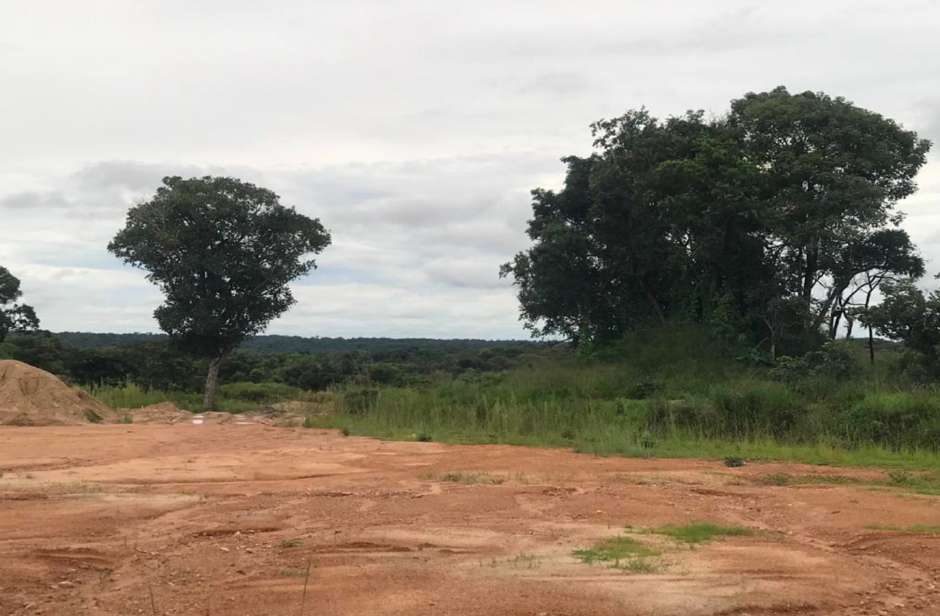
Open Miombo woodland on the Kalumbila site, cleared access track in the foreground

Kokeb Enterprises Limited · Energy · Solwezi–Kalumbila corridor, Zambia

Fuel today. Power tomorrow. One licensed operator in the corridor.

Kokeb's energy business runs on two tracks: Novea Energies, a licensed oil marketing company and energy trading platform already on the ground in Solwezi, and a 100 MWp solar plant on Kokeb's own 250-hectare site, 25 km from Barrick Lumwana mine. Both are open to investors and offtakers.

Novea Energies · Kokeb Enterprises Limited trading as Novea Energies

Licensed, built, and buying fuel in its own name.

Novea Energies is the operating arm of Kokeb's energy business: an ERB-licensed oil marketing company with its own inspected and licensed forecourt in Solwezi, a throughput agreement at the TAZAMA depot, and a trading platform designed to carry the same discipline into electricity.

NoveaENERGIES

Powering a New Era

OMC licenceEnergy Regulation Board, 2026–2031 Retail licenceEnergy Regulation Board StorageHospitality agreement with TAZAMA Petroleum Products, Solwezi Fuel Depot ElectricityTrading and Supply licence applications lodged with the ERB, September 2026 ForecourtBuilt, ZEMA-approved, inspected by the ERB and licensed to retail

Electricity

Aggregator and supplier, not only a generator

The plan is to buy from independent producers and the Southern African Power Pool, add Kokeb's own generation at Kalumbila, and sell to mines, commercial customers and licensees under ERB trading and supply licences. The Kalumbila plant is the first owned asset in that portfolio; the licences are what let Novea firm up a solar-only supply with traded power.

Platform

noveaenergies.com

Novea's own software, live at app.noveaenergies.com: prepaid vending and wallets, tariff and load-shedding management, wet-stock and shift reconciliation for forecourts, OMC returns and licence tracking, and a trading, wheeling and settlement ledger. Built for Zambia first, with the SADC markets reachable by configuration. ZRA Smart Invoice integration in progress.

Kalumbila 100 MWp Solar PV

100 MWp of solar, 25 km from Lumwana mine, on land we already own.

A utility-scale photovoltaic plant on Kokeb's 250-hectare titled parcel in Manyama, Kalumbila District, built to supply Barrick Lumwana directly over a short private line and to inject into the national grid as a second route to market. Modelled on Chisamba, Zambia's first 100 MW solar plant, which delivered 187.7 GWh in its first year.

100MWpInstalled capacity, phase one
250HaTitled land, Kokeb-owned
185GWh/yrExpected generation (P50)
5.8kWh/m²/dayGlobal horizontal irradiance
~25kmTo Barrick Lumwana mine
3.3kmTo nearest transmission line

Why now

The Lumwana–Kalumbila corridor is the fastest-growing load in Zambia, and it runs on a grid that cannot keep up.

Mining consumes just over half of all electricity generated in Zambia. Two of the country's largest mines sit within 35 km of this site, and one of them is in the middle of a USD 2 billion expansion.

USD 2bn

Lumwana super-pit expansion

Barrick is expanding Lumwana into a Tier 1 copper asset. Processing capacity roughly doubles, and with it the mine's firm power requirement.

51%

Mines' share of national demand

Lumwana and FQM's Sentinel are the two largest loads in the province. Load-shedding to households is already routine; mines need firm, contracted supply.

3.2 → 10 GW

National capacity target

Government aims to grow installed capacity from 3,225 MW (2021) to 10,000 MW by 2030, with private IPPs doing most of the building.

187.7 GWh

Chisamba, year one

Zambia's first 100 MW solar plant, commissioned June 2025, out-performed its forecast in its first year. The 100 MW second phase came in at about USD 70 million. The template works here.

8.1%

Manyama population growth

Against a provincial average of 4.8%. Grid power already reaches most households; supply, not connection, is the constraint.

2

Interconnectors under way

Zambia–DRC and Zambia–Tanzania links open the Katanga mining belt and the East African Power Pool to Zambian exports.

The site

Flat, titled, unoccupied, and 4.6 km off the Solwezi–Mwinilunga road.

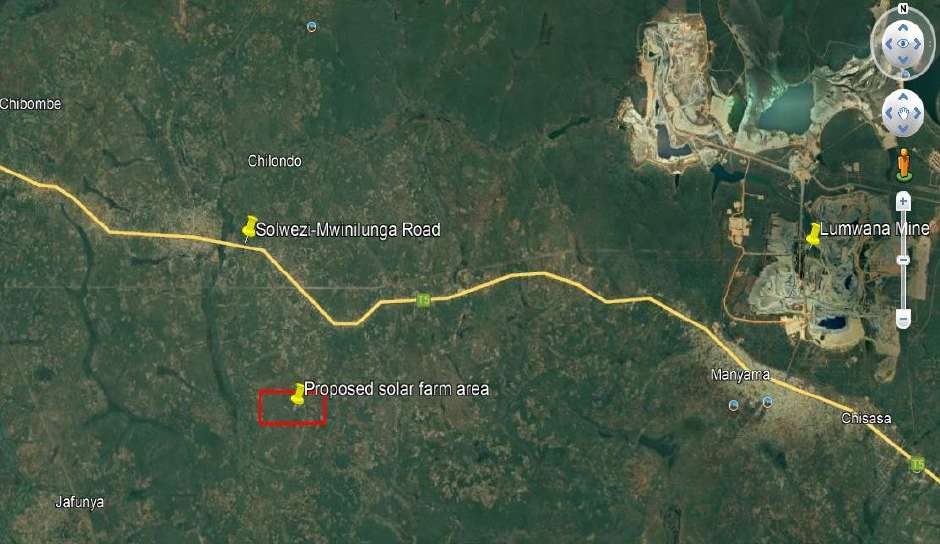
The parcel sits in Chief Mukumbi's area, about 19 km from Lumwana trading centre towards Kalumbila. Kokeb holds it under a Title Deed, with a 3.6 km all-weather access road already built.

Satellite map showing the proposed solar farm area south of the Solwezi–Mwinilunga road, with Lumwana Mine to the north-east
Figure 1 from the pre-feasibility report. The site lies south of the Solwezi–Mwinilunga road; Lumwana Mine is to the north-east.

Terrain

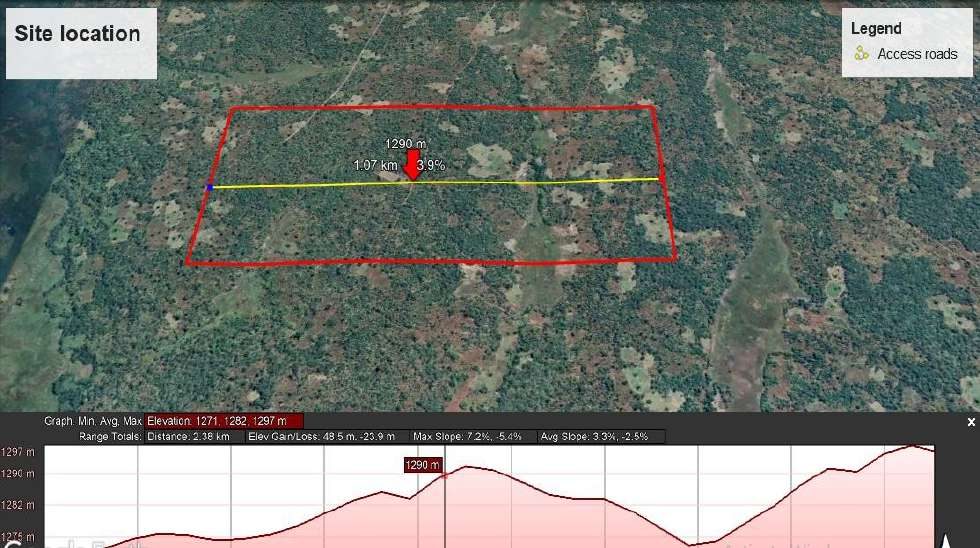
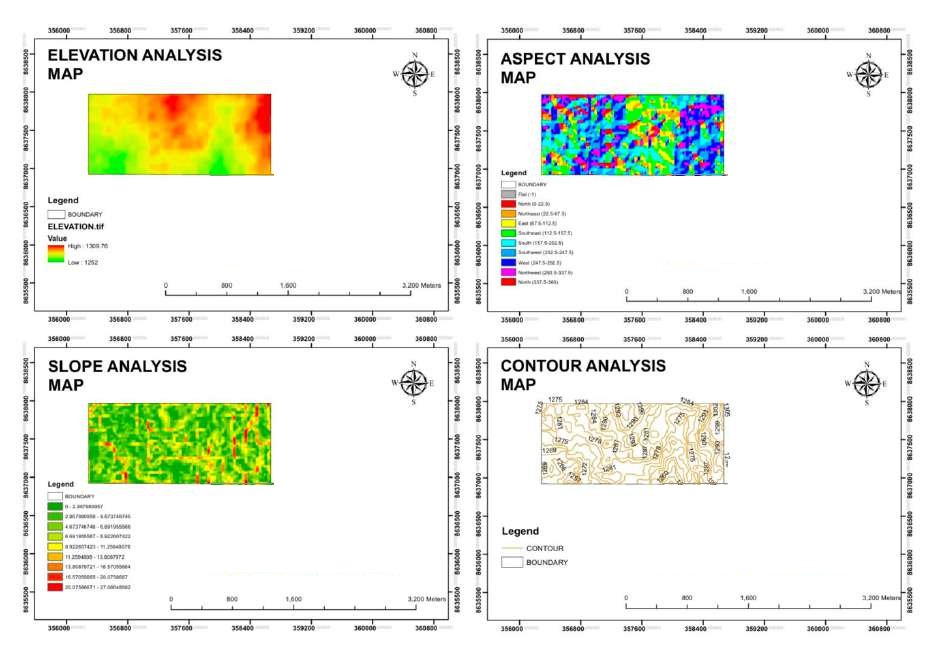
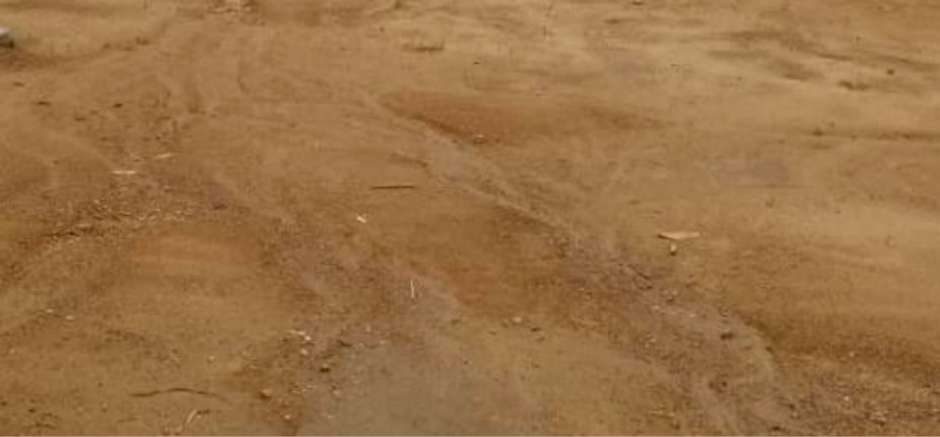
Over 90% of the site is uniform and level, on white sandy soil with good bearing for driven piles. Average elevation 1,280 m, with a gentle 5–7% fall south-west to the Keombe Stream, which provides natural drainage. No flooding on record.

Land use and people

No permanent households. Roughly 20 seasonal crop fields and temporary thatched shelters, so compensation obligations are small and resettlement is nil. Councils, the Ward Development Committee and the chieftaincy remain the partners for wayleaves and consultation.

Ecology

Open, moderately disturbed Miombo woodland (Julbernardia, Isoberlinia, Brachystegia). No endangered or protected species, no gazetted reserve, no wildlife corridor, no archaeological or heritage sites within the boundary. The dambo along the stream is about 5% of the area and is excluded from the panel field.

Site boundary overlaid on aerial imagery with an elevation profile across the parcel
Boundary and elevation profile (1,271–1,297 m along the transect).
Four GIS panels: elevation, aspect, slope and contour analysis of the parcel
Elevation, aspect, slope and contour analysis of the parcel.
Close view of the pale sandy soil on site
Free-draining sandy soil: good for piling, poor for little else, which is why it is not under competing use.
Corner beaconEastingNorthingDatum
1356 288.758 637 972.32UTM zone 35S
2358 670.758 637 972.32
3358 670.758 636 922.79
4356 288.758 636 922.79

Route to market

Two ways to sell the power. The short one is the point.

Most Zambian IPPs sell to ZESCO and depend on long transmission lines, wheeling charges and a single state counterparty. This site is close enough to Lumwana to run a dedicated line to the mine. The grid becomes the back-up route, not the only one.

Schematic of supply routes from the solar site Kokeb site 100 MWp PV Lumwana Barrick mine ~25 km dedicated line Power Supply Agreement, no wheeling ZESCO substation / grid 3.3–18 km tie-in wheeling

Direct supply under a Power Supply Agreement

A short private line from the site to the mine. Barrick gets contracted daytime energy at a fixed USD tariff behind its own fence, with no ZESCO transmission losses, no wheeling tariff and no exposure to national load-shedding. Kokeb gets an investment-grade counterparty whose expansion needs exactly this power. Partial grid connection is retained for stability and for selling surplus.

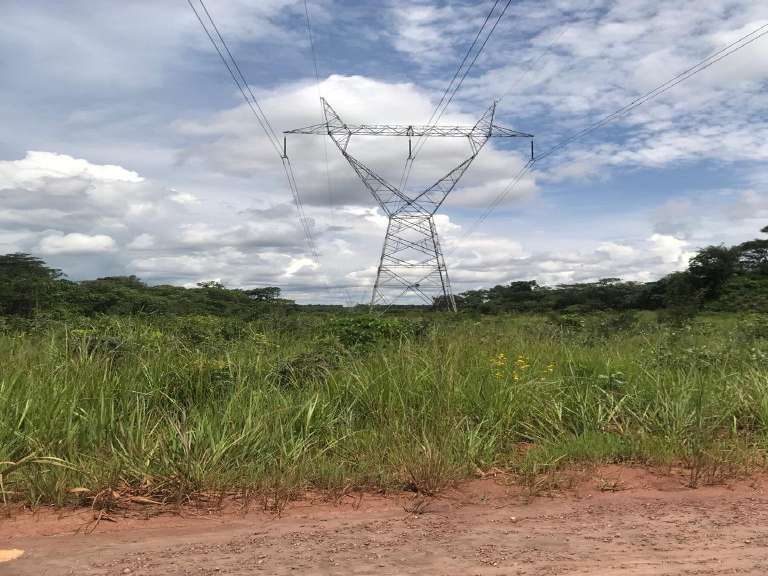
Steel lattice pylon carrying the Kalumbila–Lumwana transmission line through grassland near the site
The Kalumbila–Lumwana line passes about 3.3 km north of the site.
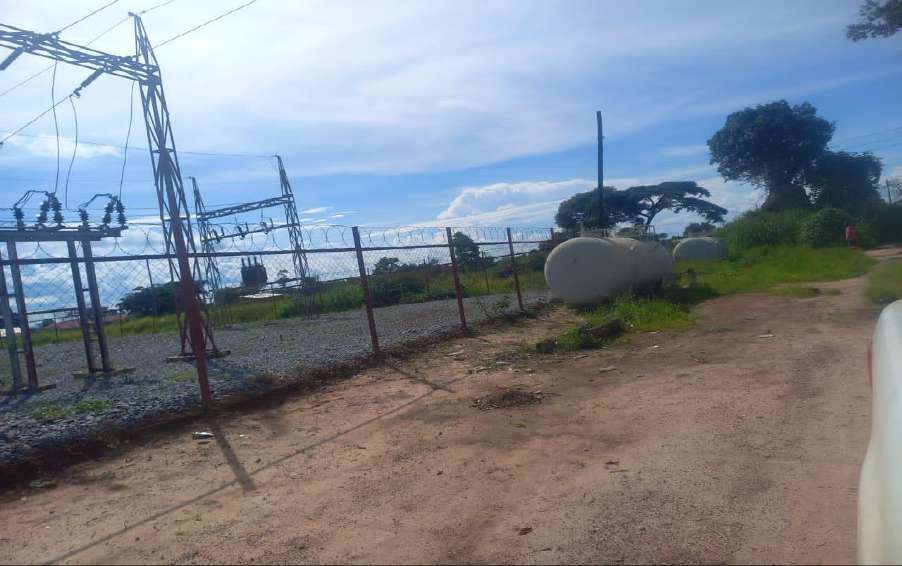
ZESCO substation with step-down transformers and switchgear
Substation identified in the area, stepping 330 kV down to 132 and 66 kV.

Grid tie-in options

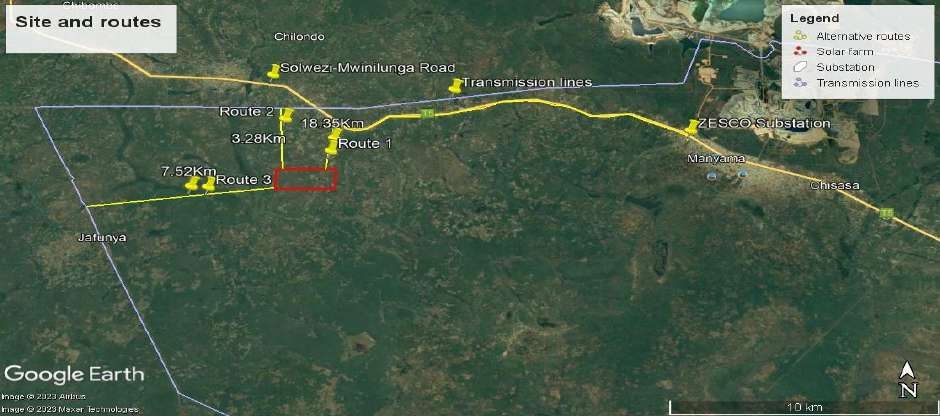
Three termination points, three voltages, all within 19 km.

Route 2 3.28 km

Due north to the Kalumbila–Lumwana transmission line. Crosses about five crop fields and no houses. Cheapest tie-in and the base case.

Route 3 7.52 km

Links the southern end of the site to the Kasempa-bound line. Avoids houses, minimal crops, more clearing than Route 2.

Route 1 18.35 km

Along Keombe Road and the Solwezi–Mwinilunga road to the ZESCO substation at Lumwana Manyama. Follows existing road reserve; compensation likely at two junctions.

Map of the three candidate transmission routes from the site to nearby lines and the ZESCO substation
Route 2 is the shortest and the base case for grid connection.
LineSuits
330 kVNational backbone. Future expansion beyond 100 MW and export through the regional interconnectors.
220 kVStable evacuation to the North-Western mining load: FQM Sentinel and Barrick Lumwana.
66 kVClosest to site. Cost-effective medium-voltage injection for local consumption in Kalumbila District.

Financial model

Move the sliders. The numbers recompute.

An unlevered, pre-tax, real-USD model over a 25-year life with 0.5% a year module degradation. It excludes financing structure and ZDA fiscal incentives, both of which improve the equity case. Indicative pending the full feasibility study.

IRENA/BNEF Sub-Saharan benchmark USD 850–1,000/kWp. Chisamba phase II: about USD 700/kWp.
A direct PSA with a mine typically prices above a ZESCO PPA, against the mine's blended grid-plus-diesel cost.
Chisamba delivered 1,877 kWh/kWp in year one at a lower-irradiance site.
About USD 13–15/kWp/yr: cleaning, vegetation, inverters, insurance, staff.
Zambia infrastructure cost of capital is typically around 10%; DFI blended finance brings it lower.
Total capitalUSD 90.0m100,000 kWp × cost/kWp
Year-one revenueUSD 12.95m185.0 GWh × tariff
Project IRR11.7%unlevered, pre-tax, real
Simple payback7.7 yrscapital ÷ year-one net cash
NPVUSD 11.5mat 10.0%
Levelised cost6.3 ¢/kWhdiscounted at 10.0%

Cumulative net cash, USD million

Headline from the report, for reference: at USD 100 million capital and a USD 0.07/kWh tariff, year-one revenue is USD 12.95 million and simple payback 8.6 years. Capital is the lever that matters most; every USD 50/kWp saved adds roughly 0.8 points of IRR.

ESG and permitting

Built to IFC Performance Standards from the first drawing.

The lenders this project is designed for will ask for an ESIA, a Biodiversity Management Plan and a grievance mechanism before they ask for a tariff. The site gives us an easy start; the process gives us the paperwork.

Environment

Low-sensitivity site, managed properly

Riparian buffer along the Keombe Stream kept as an avoidance zone. Elevated mounting and wildlife-permeable fencing. Indigenous revegetation under and between rows, with agrivoltaic grazing or legume cropping where it works. Module take-back scheme written into the EPC contract.

Social

Local jobs, local power

Construction employment drawn from Manyama and Kalumbila. Compensation for seasonal fields under the Environmental Management Act and IFC PS5. A permanent O&M team based on site. Community consultations to date have been supportive.

Governance

Zambia Power Development Framework

Feasibility rights through OPPPI at the Ministry of Energy; ESIA with ZEMA; Generation Licence from the ERB (25-year minimum term); grid impact study and connection agreement with ZESCO; ZDA investment certificate for duty and VAT relief on plant.

Development pathway

From pre-feasibility to financial close.

  1. Completed

    Pre-feasibility report

    Site, solar resource, hydrology, ecology, socio-economics, grid options and indicative financials. The document behind this page.

  2. Next

    Feasibility study rights and offtaker term sheet

    OPPPI application. In parallel, a non-binding term sheet with Barrick Lumwana for direct supply, and an expression of interest from ZESCO for grid offtake.

  3. 2027 H1

    Bankable feasibility study

    Twelve months of ground-measured irradiance, geotechnical investigation, topographic survey, ESIA to ZEMA, grid impact study with ZESCO, and a lender-grade financial model.

  4. 2027 H2

    Licences, PPA/PSA and financial close

    ERB Generation Licence, signed offtake agreement, EPC and O&M contracts, debt and equity committed. Target financial close: Q4 2027.

  5. 2028

    Construction and commercial operation

    Chisamba's second phase was built in seven months. A twelve-month programme to COD is conservative for a flat, dry, titled site with an access road already in place.

What we are looking for

Partners for three seats at the table

Offtaker. A mine or industrial user in the corridor willing to sign a long-term USD-denominated supply agreement.

Equity partner. A developer or fund to co-invest alongside Kokeb's land and development work.

Lender. A commercial bank or DFI. Stanbic Bank Zambia has expressed interest and is willing to provide a letter of support.

What Kokeb brings

Land, licence to build, and a local balance sheet

250 Ha on title with road access; NCC Grade I certification in building, civil, road, electrical and mechanical works, so civils and balance-of-plant can be self-performed; an operating base in Solwezi; Novea Energies' ERB licences and trading platform to firm and sell the output; and a decade of delivery in the province.

Risks

What could go wrong, and what we have done about it.

Offtaker concentration and credit

A single-mine PSA is the strongest commercial case and the biggest concentration risk. Mitigation: a dual route to market (direct line plus grid tie-in), a take-or-pay floor in the PSA, and an investment-grade parent guarantee from the offtaker group.

Currency

Capital and debt are in USD. The tariff will be USD-denominated and indexed, whether under a ZESCO PPA (as at Chisamba) or a mine PSA. No kwacha revenue is assumed in the model.

Grid access and curtailment

Three tie-in points at three voltages within 19 km. A grid impact study with ZESCO is the first technical deliverable of the feasibility phase. Direct supply to the mine reduces dependence on grid absorptive capacity.

Resource and yield

The 185 GWh figure rests on satellite data (SolarGIS, NASA POWER). The feasibility phase adds twelve months of on-site measurement. Chisamba's first-year result of 187.7 GWh from 100 MW, at a less sunny site, is the best local evidence the estimate is sound.

Land and community

Kokeb holds the Title Deed. No permanent dwellings on site. Seasonal users are known to the community and will be compensated under the Environmental Management Act and IFC PS5. The chieftaincy and district council are engaged for wayleaves.

Construction and technology

Tier 1 mono-PERC or TOPCon modules under EPC performance warranty; a long-term O&M contract; wind loading to 11 m/s and hail considered in the mounting design. Rainfall over 1,000 mm a year is addressed by preserving the natural drainage pattern rather than regrading.

Regulatory timing

The licensing pathway under the Zambia Power Development Framework is defined and has been walked by Chisamba. Stakeholder engagement with OPPPI, ERB, ZEMA and ZESCO begins before the feasibility study, not after it.

Kokeb Enterprises Limited

Let's talk about fuel and power in the corridor.

Kokeb is a diversified Zambian group with operations in engineering and construction, property, energy, critical minerals, logistics and technology, concentrated in the Solwezi–Kalumbila corridor. Novea Energies is seeking equity investors across fuel and electricity; the Kalumbila plant is seeking an offtaker, an equity partner and a lender. Both are run from Kokeb's Solwezi base.

Moses Marcos, Chief Executive Officer and Managing Director

Phone / WhatsApp+260 97 409 4000 Emailinfo@kokebenterprises.com Webwww.kokebenterprises.com SolweziStand No. 7745, Kansanshi Road LusakaPlot 610/4AA, Zambezi Road, Foxdale